Ath M70X Review: Real User Experience After 3 Months
There is a specific kind of anxiety that comes with spending significant money on a piece of gear that is marketed as a "precision instrument." When I finally decided to pull the trigger on the Audio-Technica M70X three months ago, I wasn't looking for a casual listening companion to wear on the bus or a bass-heavy set of cans to make my modern pop tracks sound "fun." I was looking for the truth—unvarnished, clinical, and sometimes painful audio truth. I’m a freelance editor and occasional location sound recordist, and I needed something that would tell me exactly where my noise floor sat and where my EQ cuts were getting messy. After ninety days of daily use, spanning across video editing suites, late-night mixing sessions, and even a few long-haul flights, I’ve found that the M70X is exactly what it claims to be, for better and for worse.
Initial Expectations vs. Physical Reality
When I first unboxed these, I was coming from years of using the ubiquitous M50X. Like many others, I assumed the M70X was simply a "premium M50X." Within ten minutes of holding them, I realized how wrong that assumption was. The build quality immediately felt different—less plasticky, more purposeful. The yokes are made of a sturdy aluminum alloy rather than the thick plastic of its younger sibling. However, I noticed right away that they don't fold up into a compact ball. If you are used to the "origami" style folding of the M-series, you’ll be disappointed. They lay flat, but they remain large. I’ve found that this actually makes them more durable in the long run, as the folding hinges on my old pairs were always the first point of mechanical failure.
One thing that bothered me during the first week was the clamping force. It is firm. I have a medium-sized head, and for the first few sessions, I felt like my skull was being measured for a hat. But, and this is crucial, the M70X is surprisingly light. After the first fortnight, the headband loosened just enough to become comfortable for four-hour stretches. I noticed that the ear pads are slightly thinner and deeper than the M50X, which helps with the precision of the driver placement relative to your ear canal, but they can get a bit sweaty in a room without air conditioning.
The Sound Profile: A Clinical Deep Dive
I’ve been using these for critical monitoring, and the word I keep coming back to is "analytical." If you are looking for a warm, cozy sound to relax to, please look elsewhere. In my experience, these headphones are like a high-powered microscope for your ears. The frequency response is advertised as 5Hz to 40kHz, and while I certainly can't hear up to 40kHz, the extension in the high-end is where these headphones earn their keep.
The Treble: Sharpness with a Purpose
What I found was that the M70X highlights sibilance and harshness in a way that is almost aggressive. During a podcast edit last month, I was working with a guest who had a naturally "whistly" S-sound. On my studio monitors, it sounded acceptable. When I put on the M70X, it was piercing. At first, I thought the headphones were the problem, but then I realized the headphones were simply showing me a problem I had missed. Once I de-essed the track based on what I heard in the M70X, the mix translated perfectly to every other system. That is the value of these headphones: they don't lie to you.
The Midrange: Clarity and Separation
In many closed-back headphones, the lower-mids can get "boxy" or "muddy" because of the internal air pressure. I was surprised by how clean the M70X sounds through the 300Hz to 1kHz range. Vocals sit exactly where they should. When I'm editing dialogue, I can hear the tiny mouth noises, the rustle of clothing, and the subtle shifts in room tone that cheaper headphones smear over. After testing for three months, I've found that they are exceptional for "surgical" EQ work. If you need to find a resonant frequency in a snare drum, you will find it within seconds with these.
Discover deals on Audio & Headphones — updated daily.
See Deals →The Bass: Where Most People Will Be Divided
Let's talk about the low end because this is usually where people get frustrated. These are not "bass-head" headphones. In fact, if you are used to consumer brands or甚至 the M50X, you might find the M70X "thin" at first. I certainly did. For the first three days, I felt like the kick drums lacked "thump." However, after about fifty hours of constant playback, I realized that the bass is simply very fast and very flat. It doesn't bleed into the mids. It doesn't bloom. It hits, and then it stops. I noticed that when I mix bass on these, I tend to push the low end a bit too much because I'm looking for that physical sensation, so I've had to learn to trust the visual meters alongside what I'm hearing.
Real-World Challenges and Disappointments
No product is perfect, and after three months, the honeymoon phase is definitely over. One specific disappointment a real owner would notice is the cable proprietary-ness. Audio-Technica includes three cables (a long straight, a short straight, and a coiled), which is great. However, the locking mechanism is unique. If you're on a field recording job and you forget your cable, you can't just grab a standard 3.5mm or 2.5mm cable from a local electronics store and expect it to fit into the recessed jack. I had a minor panic at a gig two months ago when I thought I’d misplaced the coiled cable, only to find it tucked in the lid of the case.
Another thing I noticed is the isolation. For a closed-back headphone, they don't isolate as well as the specialized "high-isolation" models used by drummers. T…
Comparison of the Audio-Technica Monitor Series
To put my experience into context, it helps to see where these sit in the hierarchy. I’ve owned or used all three of these models over the years, and the M70X is a distinct departure from the others.
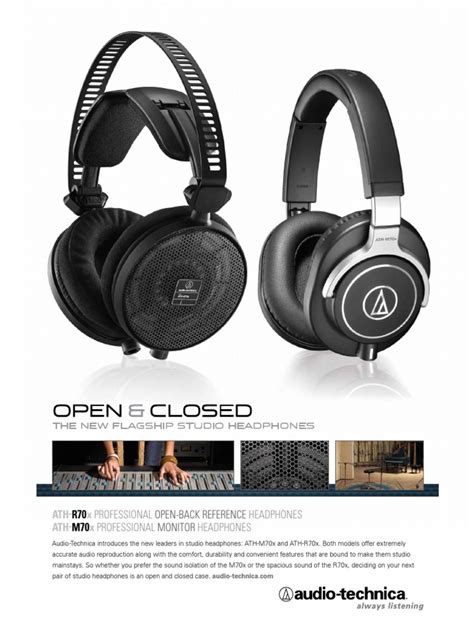
| Feature | ATH-M40X | ATH-M50X | ATH-M70X |
|---|---|---|---|
| Sound Signature | Neutral/Flat | V-Shaped (Bass/Treble Boost) | Analytical/Clinical |
| Driver Size | 40mm | 45mm | 45mm (Proprietary) |
| Housing Material | Plastic | Plastic | Aluminum Alloy/ABS |
| Frequency Range | 15Hz - 24kHz | 15Hz - 28kHz | 5Hz - 40kHz |
| Best Use Case | General Studio/Budget Friendly | DJ/Tracking/Casual Listening | Mixing/Mastering/Forensic Audio |
| Weight (no cable) | 240g | 285g | 280g |
Managing the "Bore-Out" Factor
There is a phenomenon I call "audio fatigue" that happens when you use very bright headphones. Because the M70X emphasizes the high frequencies so accurately, long sessions can be tiring. I found that I had to take a 10-minute break every hour to give my ears a rest. This isn't necessarily a flaw of the headphone; it's a byproduct of the detail level. If you are listening for pleasure, this might be a dealbreaker. If you are listening for work, it’s a sign that you are actually hearing everything. I've used these for several "marathon" editing sessions, and while my ears felt a bit "crispy" afterward, the quality of the work was significantly higher than when I used smoother, more forgiving headphones.
Pros & Cons After 3 Months
- Pro: Surgical Accuracy — The ability to hear minute details in the high frequencies is unparalleled in this price bracket. I can hear compressor artifacts and digital jitter that were invisible to me before.
- Pro: Build Durability — The metal yokes and high-quality plastics have held up perfectly. After 90 days of being thrown into backpacks and desk drawers, there isn't a single creak or squeak in the frame.
- Pro: Accessories — The hard carrying case is excellent. It actually protects the headphones, and the interior pouch for the three included cables is a lifesaver for organization.
- Pro: Comfort for Weight — Despite the initially high clamping force, they are light enough that I don't get "hot spots" on the top of my head, which is a common issue with heavier studio cans.
- Con: Lack of "Soul" — For music enjoyment, these can feel clinical and boring. They don't color the sound to make it "exciting." If a song is mixed poorly, it will sound terrible on these.
- Con: Proprietary Cable Jack — The deep, locking 2.5mm jack makes it nearly impossible to use third-party cables without a very specific adapter.
- Con: Limited Portability — The fact that they don't fold makes them take up a lot of real estate in a bag compared to the M50X or even many high-end Bose or Sony models.
- Con: Bass Performance for Consumers — The sub-bass is present but lacks the visceral "oomph" that most modern listeners expect, making them poor choices for EDM or Hip-Hop fans who aren't producers.
The Buying Guide: Who is the M70X actually for?
Buying headphones in the $250–$300 range is tricky because you are entering the territory of "diminishing returns." Based on my experience, I’ve identified three types of people who should buy these and three types who should stay far away.
Find top-rated Audio & Headphones products at great prices.
Shop Amazon →You SHOULD buy the M70X if:
You are an audio engineer or video editor who needs to ensure your work translates across multiple systems. If your primary goal is finding errors in recordings—like room hiss, digital clipping, or plosives—these are your best tools. I also recommend these for people who live in warmer climates because they are lighter and slightly more breathable than the "leather-heavy" luxury headphones. Finally, if you are someone who hates "muddy" sound and values clarity above all else, you will love the transparency here.
You SHOULD NOT buy the M70X if:
You are looking for headphones for "gaming and movies." The flat bass will make explosions sound weak, and the height of the treble might make gunshots sound painfully sharp. You should also avoid these if you primarily listen to low-quality MP3s or poorly recorded lo-fi tracks; the M70X will expose every single flaw in the recording and make the experience unpleasant. Lastly, if you have a very large head, the clamping force might never reach a "comfortable" stage for you, as the metal yokes have less "give" than plastic ones.
Final Thoughts After the 90-Day Mark
The Audio-Technica M70X has become an essential part of my workflow, but it hasn't replaced my other headphones for casual use. When I want to listen to a new album and just enjoy it, I still reach for my open-back HiFi cans or even my noise-canceling buds. But when I am "on the clock," the M70X is the only thing I trust. It’s not a "fun" headphone, and it’s not trying to be your friend. It’s a tool—a sharp, cold, incredibly precise tool.
What I found most interesting over these three months is how my own hearing has seemingly "calibrated" to them. When I switch back to other headphones now, they often sound muffled or veiled. The M70X has taught me how to listen more critically. I was surprised by how much "ghost" noise exists in my favorite professional recordings that I simply never noticed before. While the price is a step up from the entry-level studio standards, the peace of mind knowing that I’m seeing the "full picture" of my audio is worth every penny. For the professionals, the M70X is a workhorse that delivers exactly what it promises: the truth, and nothing but the truth.